
Paul Barbagallo |
On my graduate-school professor’s office door, a sign read “Head Learner”. Beneath it, amid a clutter of sign-up sheets, stray Post-its, and flyers, another implored: “No Whining.”
I doubt their pairing was deliberate, but together they conveyed a truth that I came to appreciate more fully in 2025: Learning isn’t always comfortable; it requires curiosity, humility, and a willingness to keep going when things get hard (sans complaining).
As director of thought-leadership content and editor-in-chief of Compass by Guild, my job is to learn from people who are actively shaping the future of work — to listen closely, ask the right questions, uncover what’s working, challenge my assumptions and those of my colleagues — and then translate those learnings into practical, differentiated, accessible guidance for others. It’s work that requires its own kind of resilience — a willingness to sit with ambiguity, to push past easy answers in search of something more original and more useful for readers, and to stay curious and diligent even when the work feels messy, complex, or disorienting.
While many of my colleagues at Guild would challenge me for the title of “head learner,” my role does indeed afford me a special vantage point. I get to see how ideas evolve before they become practice, and how practice evolves before it becomes thought leadership.
So, from 50+ Compass articles we published this year, here are the learnings that have stayed with me.
1. For learning to matter, it must become infrastructure for business performance.
If you’re reading this, you’re probably feeling the pressure to make your learning-and-development function and investments work harder than ever before — to advance upskilling and reskilling, accelerate digital and AI transformation, strengthen workforce resilience, and support talent development, all virtually at the same time.
It was in response to this pressure that Guild conducted a survey of 500 HR and L&D leaders across myriad industries and sectors in the U.S. from January to March of this year. We wanted to better understand how HR practitioners were aligning L&D with business priorities (if at all), what kind of results they were getting, and what metrics they were using to measure success.
What we found — and I learned — was sobering. Almost 30% of CHROs and L&D leaders said they believe L&D investments had “unknown, little, or no impact” on revenue or profit margin, the clearest sign yet that the HR field is still struggling to demonstrate tangible business value. At the same time, the leaders in our study who tie learning directly to their company’s biggest business priorities are 122% more likely to meet or exceed their top metrics.
As one leader told us, “We’re not here to deliver training. We’re here to improve how the business works,” one leader told us.
2. The skills once considered ‘safe’ in the AI era aren’t safe anymore.
One of the most viral Compass articles this year came from Guild’s Matthew Daniel and Alex Cannon, who uncovered that many companies, despite their better intentions, are clinging to outdated notions of what constitutes a “durable skill.”
We’ve long believed that soft skills such as communication, empathy, coaching, and critical thinking are safely “human” and less likely to be automated. And in many ways, that’s true. But if you’ve interacted with AI recently, you know bots can now approximate these skills surprisingly well.
What remains radically and distinctly human — and far harder for AI to replicate, at least for now — are the more subtle capabilities Daniel and Cannon explored:
Interpretative thinking: the ability to make sense of mixed signals. When an employee says, “I can’t do that right now,” a bot might simply move on. A human hears the tension underneath.
Contextual fluency: knowing what matters in the moment. AI can schedule meetings at scale; it can’t always recognize when not to send the invite — like after a team has just been through a difficult layoff.
Situational ethics: acting when the rules don’t cleanly apply, and judgment matters more than procedure.
3. Change leadership is the new change management.
In another popular Compass article this year, Matt Burr, editor in chief of Guild Academy, argued that traditional “change management” is reaching its limit; according to Burr, it’s too reactive, too episodic, too disconnected from the people actually doing the work. What organizations need instead, he argued, are “change leaders” — individuals across the business who can navigate ambiguity, interpret signals, and keep teams steady even as strategy evolves.
Case in point: When Ann Thai, head of team member development at Shipt, set out to create the grocery-deliver service’s first-ever learning function, she focused on making change a capability. As Thai shared with Compass, employees needed help understanding and managing change. From that insight, Navigating Change — the first program under the newly launched Shipt Academy with Guild — was born. Designed as social, cohort-based learning, the program focuses on equipping employees with the tools to move through change with intention, which also happens to be a core business priority for Shipt.
4. Resilience has become the defining competitive differentiator of our times.
If there was one theme that cut across everything we published across Compass content this year, it was the emergence of resilience as the new foundation for business transformation, innovation, people leadership — and even, increasingly, competitive advantage. Now, I am the first to admit that resilience, no matter how useful a term, has long been a buzzword. For years we’ve seen the term invoked liberally in public health, consumer spending, cybersecurity risk management, financial investments, labor markets, and business strategies. But 2025 became the year that resilience transcended rhetoric and became the work.
In her essay “What is the Resilience Economy?” Guild CEO Bijal Shah argued that resilience has overtaken efficiency as the dominant economic force, and is reshaping talent strategy, organizational design, and even national competitiveness. She identified five pillars of this emerging economy, from purposeful learning cultures to the rise of “human+” capabilities that complement AI.
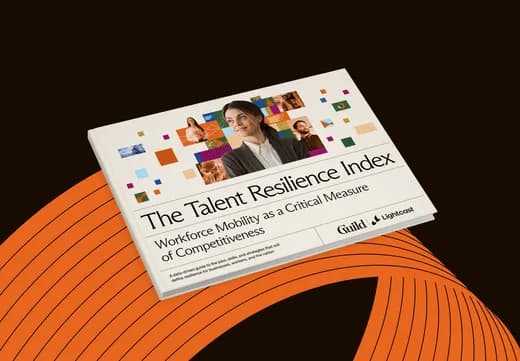
Meanwhile, the “Talent Resilience Index,” developed by Guild and Lightcast, identified workforce mobility — the ability of workers to adapt, move, and evolve to fill in-demand jobs — as one of the clearest indicators yet of resilience in action, and a key contributor to economic growth.
5. Policy is a new strategic variable, and employers must prepare for it.
2025 also brought major policy reforms that will shape the next decade of workforce development.
Guild’s thought leaders followed these developments closely — from the “One Big Beautiful Bill Act (OBBBA)” to the federal America’s Talent Strategy — and translated their implications for employers.
In her analysis on Workforce Pell, Shah showed how expanding Pell Grants to short-term programs could open new pathways for working adults and help employers close critical skill gaps, provided they understand the quality thresholds, completion expectations, and labor-market alignment the policy now requires.
In her breakdown of OBBBA’s extended Section 127 cap, she clarified how inflation-adjusted increases to tax-free education benefits could reduce gross-up costs, expand access for frontline workers, and strengthen the business case for upskilling — along with the steps HR and L&D leaders should take now.
And in her analysis of America’s Talent Strategy, she outlined how states can adapt employer-led models by co-designing training pathways, braiding funding streams, simplifying the learner journey, and measuring long-term mobility. Taken together, these insights offer leaders a coherent roadmap for turning policy change into workforce advantage.
If 2025 taught me anything, it’s that the future belongs to people and organizations that learn faster and more thoughtfully than the world changes around them. So, always be learning. And no whining.